
AC or DC: what's the difference?
Understanding EV charging: which charger to use, and which plug your car takes.
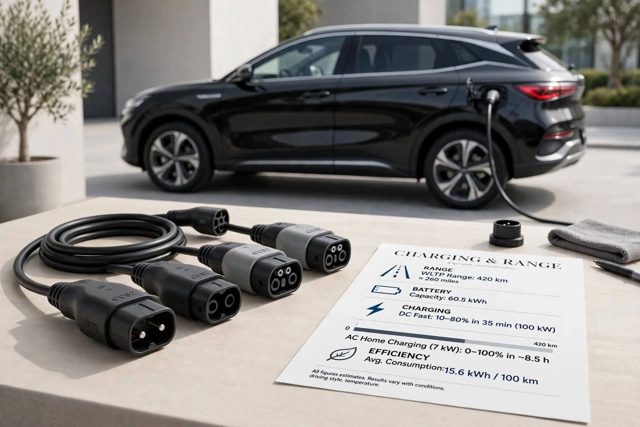
If you've recently started exploring electric vehicles, you've probably come across two common charging terms: AC and DC.
You may have seen them on charging stations, vehicle specifications or charging cables. But what do they actually mean? Is one better than the other? And how do you know which one your vehicle supports?
Understanding the difference between AC and DC charging can help you charge more efficiently, avoid compatibility problems and make better use of available charging infrastructure.
Let's break it down.
1. What is AC charging?
AC stands for Alternating Current. It is the type of electricity commonly supplied to homes, offices and many public charging locations.
When you connect an EV to an AC charging point, electricity enters the vehicle through its charging port. The vehicle's onboard charger then converts that electricity into Direct Current (DC), which the battery can store. In simple terms, AC electricity comes from the charging source, but the vehicle performs the conversion before storing the energy in its battery.
Common uses:
- Home charging installations.
- Workplace charging facilities.
- Shopping centres and destination charging locations.
- Public charging stations designed for longer parking periods.
Advantages include convenient overnight charging, usefulness at workplaces and destinations, and generally less expensive charging equipment than DC fast charging.
AC charging is generally slower than DC fast charging. Actual speed depends on the charging point's power output and the vehicle's onboard charger capacity. A vehicle capable of accepting 7 kW AC will not charge at 11 kW simply because it is connected to an 11 kW charging point.
2. What is DC charging?
DC stands for Direct Current. DC charging equipment converts electricity to the appropriate DC output within the charging station before delivering it to the vehicle's battery.
This allows electricity to bypass the vehicle's onboard AC charger, enabling much higher charging power when the vehicle supports it. DC charging is commonly known as fast charging or rapid charging.
Common uses:
- Public fast-charging stations.
- Highway and intercity charging locations.
- Commercial charging facilities.
- Stops where drivers need to recharge in a shorter period.
DC charging is generally faster and useful during longer journeys. However, equipment is more expensive and requires specialised electrical infrastructure. Not every EV supports DC fast charging, and maximum charging power varies by vehicle. Charging speed also reduces as the battery approaches a high state of charge and may be affected by battery temperature.
3. AC vs DC: what's the difference?
AC charging uses Alternating Current and conversion happens inside the vehicle. It is generally slower and commonly used at home, work and destination locations.
DC charging uses Direct Current and conversion happens inside the charging station. It is generally faster and commonly used for public fast charging and travel stops.
Both are important. The right choice depends on your vehicle, charging needs and journey.
4. Understanding charging connectors
A charging station may supply the correct type of electricity but still be incompatible with your vehicle because the connector does not match.
Type 1 (SAE J1772): an AC connector found on various older and some regional EV models.
Type 2 (Mennekes): a widely used AC connector, particularly on many European-market EVs.
CCS (Combined Charging System): supports AC and DC charging through a combined connector arrangement. CCS1 and CCS2 are different versions.
CHAdeMO: a DC fast-charging standard used by several Japanese vehicle models, including certain Nissan Leaf versions.
GB/T: a family of charging standards used by many vehicles manufactured for the Chinese market, with separate AC and DC connector arrangements.
These standards are not interchangeable simply because they may look similar. Always confirm the exact connector supported by your vehicle and the charging station.
5. Which one should you use?
Use AC charging when charging at home overnight, parking at work for several hours, visiting a shopping centre or other destination, or when you do not need a rapid recharge.
Use DC charging when travelling longer distances, recharging during a journey, working with limited time, and when your vehicle supports the station's DC connector and charging standard.
For many EV owners, a combination of AC and DC charging provides the most practical approach.
6. What determines your actual charging speed?
Even when a charging station advertises a particular power output, your vehicle may not receive that full amount.
Charging speed can depend on:
- The maximum AC or DC charging power supported by your vehicle.
- The charging station's available power.
- Battery temperature.
- Current battery charge level.
- Battery management system limitations.
- Electrical supply conditions.
- Power sharing between multiple charging connectors.
A DC charging station rated at 100 kW will not necessarily charge every connected vehicle at 100 kW. Your vehicle determines how much power it can safely accept at any given time.
7. What should Ghanaian EV owners know?
As EV adoption grows in Ghana, understanding charging compatibility is particularly important. Vehicles entering the market may come from Europe, China, Japan, Korea and North America, and can support different charging connectors and standards.
Before purchasing an EV or using a public charging station:
- Check the vehicle's charging specifications.
- Confirm whether it supports AC charging, DC fast charging or both.
- Identify its exact charging connector.
- Check the voltage and power requirements.
- Confirm that the charging station supports your vehicle.
- Use approved adapters only where the vehicle and charging equipment manufacturers permit them.
Never assume that a charging station will work with your vehicle simply because it has an EV charging label.
Final thoughts
AC and DC charging serve different purposes, and both are important to the electric mobility ecosystem.
AC charging is particularly useful for everyday charging when your vehicle will be parked for several hours. DC charging offers faster energy replenishment when time matters.
Understanding the difference allows you to choose the right charging option, avoid unnecessary delays and plan your journeys with greater confidence.
NexaFix helps connect EV owners with charging information, compatible charging options and essential mobility resources, making it easier to navigate the growing electric vehicle ecosystem.