
How to plan your first EV charging stop
A simple guide to your first public charge, from planning the stop to unplugging.
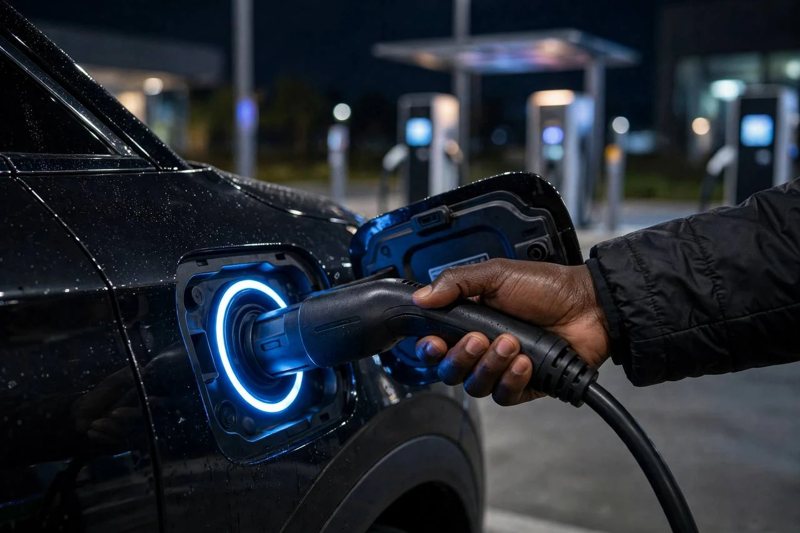
Charging an electric vehicle for the first time at a public charging station can feel unfamiliar, especially if you have spent most of your driving life visiting petrol stations.
Where do you find a charging station? How do you know whether it is compatible with your vehicle? How long should you charge? And what happens if the charger does not work?
The good news is that public EV charging becomes much easier once you understand the process.
Whether you're driving around Accra or preparing for a longer journey, this guide will help you approach your first charging stop with confidence.
1. Know your vehicle before you leave
Before looking for a charging station, understand your vehicle's charging requirements.
Charging connector: identify whether your vehicle uses Type 1, Type 2, CCS1, CCS2, CHAdeMO or another charging standard.
Charging type: confirm whether your vehicle supports AC charging, DC fast charging or both.
Maximum charging power: find out the maximum AC and DC charging power your vehicle can accept.
Battery capacity: understand the approximate usable battery capacity and how it relates to your driving range.
Manufacturer recommendations: check your vehicle manual for charging instructions and specific precautions.
Having this information makes it much easier to identify suitable charging locations.
2. Find a compatible charging station
Your next step is locating a charging station along your route. Don't just look at its distance from your location. Check whether it can actually charge your vehicle.
Confirm:
- Location and accessibility.
- Supported charging connectors.
- AC or DC charging availability.
- Maximum charging power.
- Operating hours.
- Charging fees and payment methods.
- Availability of the charging equipment.
Where possible, confirm the station's current operating status before setting off. For drivers in Ghana, consider alternative charging locations along longer routes, especially where charging infrastructure may be limited.
3. Check your battery level before setting off
Avoid waiting until your battery is almost empty before looking for a charging station.
Before leaving:
- Check your current battery percentage.
- Review your estimated remaining driving range.
- Consider traffic and road conditions.
- Account for air-conditioning use and other energy demands.
- Make sure your destination or charging stop is within a comfortable range.
Your dashboard's estimated range is a guide, not a guarantee. Maintain a reserve rather than planning a journey that depends on arriving with almost no battery charge.
4. Understand what happens at a public charging station
Although charging stations differ, the process generally follows a similar pattern.
Step 1 — Park correctly: position your vehicle so the charging cable can comfortably reach the charging port without stretching or obstructing other users.
Step 2 — Confirm compatibility: check that the connector matches your vehicle and that the station supports the charging type you need.
Step 3 — Follow the station's instructions: some chargers require you to scan a QR code, use a mobile application, tap a charging card or follow instructions on the charging unit. Payment and activation procedures vary by operator.
Step 4 — Connect the charging cable: open your vehicle's charging port and connect the cable as instructed. Some stations require connection before activation; others require activation first. Follow the equipment's instructions.
Step 5 — Confirm charging has started: check the station display and vehicle dashboard. Confirm the session is active, the vehicle recognises the connection, power is being delivered and the battery status is updating.
Step 6 — Monitor your session: keep an eye on charging progress and notifications. Follow the operator's safety and parking requirements.
Step 7 — End the session properly: use the station's app, card or display instructions to stop charging. Wait for the connector to unlock before removing it. Return the cable to its holder and close your vehicle's charging port.
5. How long should you charge?
Charging time depends on battery capacity, current battery percentage, charger power, vehicle charging limits, battery temperature and charging speed as the battery fills.
You do not always need to charge to 100%. For everyday use, many EV owners find it convenient to charge only enough to cover their next journeys with a comfortable reserve. For longer trips, you may need additional charging stops.
Always follow the battery charging recommendations for your particular vehicle.
6. What if the charging station doesn't work?
Sometimes a charging session may fail to start, stop unexpectedly or display an error.
If this happens:
- Check that the connector is properly inserted.
- Confirm that the charging session has been activated correctly.
- Check for error messages on the charger or vehicle dashboard.
- Follow the operator's troubleshooting instructions.
- Contact the charging station operator if the problem continues.
- Try another compatible charging connector or station if necessary.
Do not force a connector into the charging port or attempt to repair charging equipment yourself.
If you notice visible damage, unusual heat, smoke or a burning smell, do not use the equipment. Move away and contact the station operator or emergency services as appropriate.
7. A few first-time charging mistakes to avoid
Assuming every charger is compatible: always check the connector and charging standard.
Arriving with very little battery remaining: plan ahead and maintain a reasonable reserve.
Ignoring charging speed: a vehicle with a lower charging limit will not necessarily benefit from a higher-powered charger.
Expecting the same charging speed throughout: charging generally slows as the battery approaches a high charge level.
Forgetting payment requirements: check whether the station requires an application, card, account or other payment method.
Leaving the vehicle beyond the required charging period: be considerate of other drivers and any station parking rules.
8. Your first charging stop checklist
Before setting off, make sure you have:
- Confirmed your vehicle's charging connector.
- Identified a compatible charging station.
- Checked its availability and operating status.
- Reviewed your estimated driving range.
- Planned a suitable alternative if necessary.
- Checked the charging cost and payment method.
- Saved the station's location and contact details.
Final thoughts
Your first public charging experience does not have to be complicated.
The key is preparation. Know your vehicle, identify compatible charging stations, plan your route and understand the charging process before you arrive.
As public charging infrastructure develops in Ghana, being familiar with these basics will make EV ownership increasingly convenient.
With NexaFix, we're making it easier to discover charging resources, navigate the EV ecosystem and connect with the services that support your electric mobility journey.